Konservasi Indonesia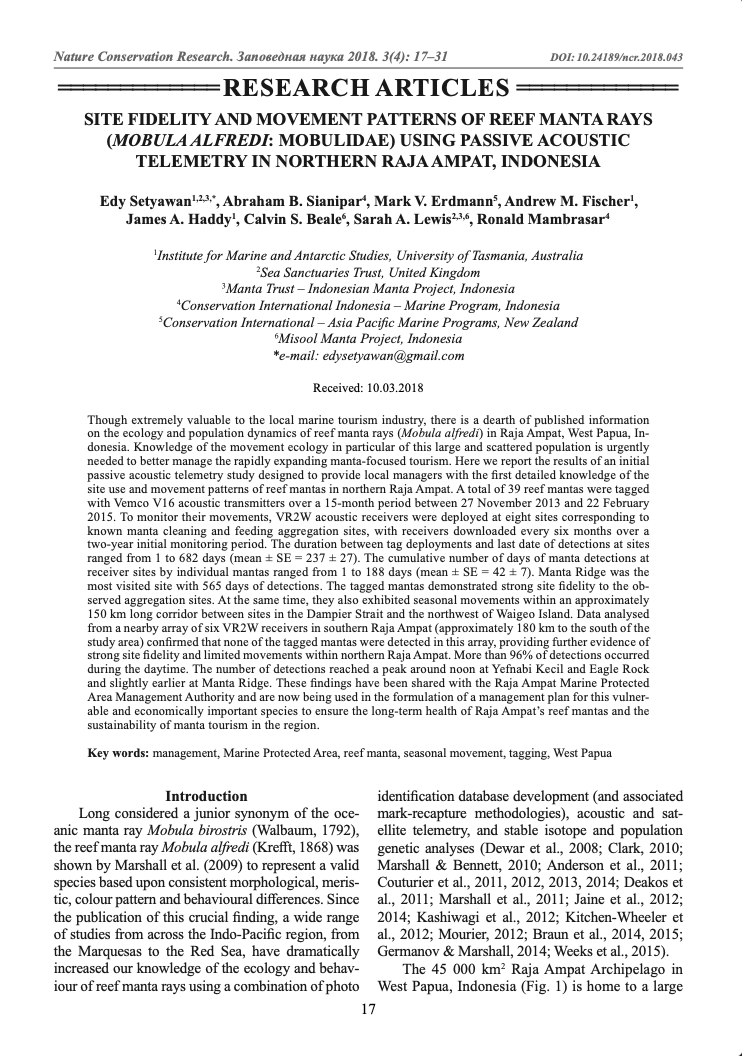
This study demonstrates strong site fidelity of reef manta rays to a small number of key feeding and cleaning aggregation sites in northern Raja Ampat, with most detections concentrated at four locations and movements largely confined to a ~100–150 km seasonal corridor influenced by monsoon-driven productivity. The limited spatial range, high re-visitation rates, and absence of connectivity with southern Raja Ampat highlight that local populations are particularly vulnerable to site-based threats, especially unmanaged tourism. These findings directly support conservation actions prioritizing strict protection and visitor management at critical aggregation sites, targeted expansion or adjustment of MPA zoning, and the use of seasonal and site-specific regulations to ensure the long-term sustainability of manta ray populations and manta-based tourism in Raja Ampat.
Authors:
Edy Setyawan; Abraham B. Sianipar; Mark V. Erdmann; Andrew M. Fischer; James A. Haddy; Calvin S. Beale; Sarah A. Lewis; Ronald Mambrasar
Publisher:
Nature Conservation Research
Keywords:
management, marine protected area, reef manta, seasonal movement, tagging, West Papua
Group Species:
Elasmobranch
Species:
Reef manta ray
Scale:
West Papua
Year:
2018