Konservasi Indonesia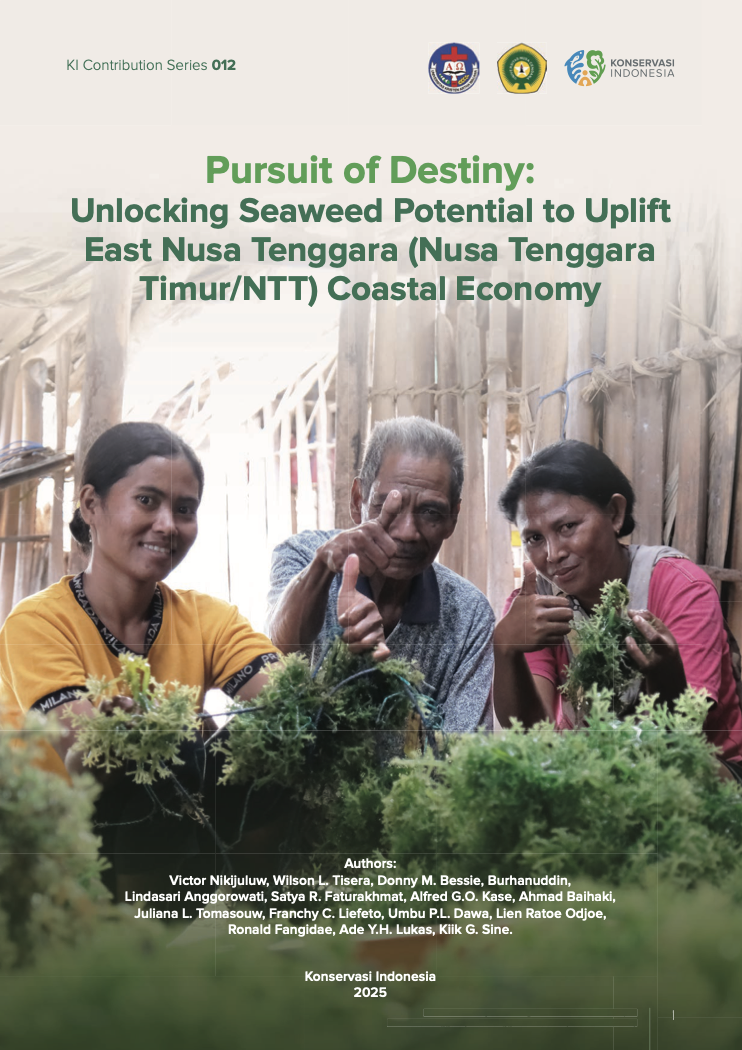
NTT is a prominent seaweed-producing province that contributes about 15% of Indonesia’s seaweed production. In 2024, the province produced 1,498,781 tons of raw dried seaweed, slightly decreasing from 1,595,378 in 2019. Seaweed production in the period of 2019-2024 was relatively stable (DKP-NTT and FPIK-UKAW, 2025). East Sumba Regency is one of the production areas, resulting in 89,300 tons, or about 6% of the provincial yield. The largest producing region in NTT, contributing about 80% of the production, is Kupang Regency. Seaweed processing companies with export market targets are located in Kupang and East Sumba.
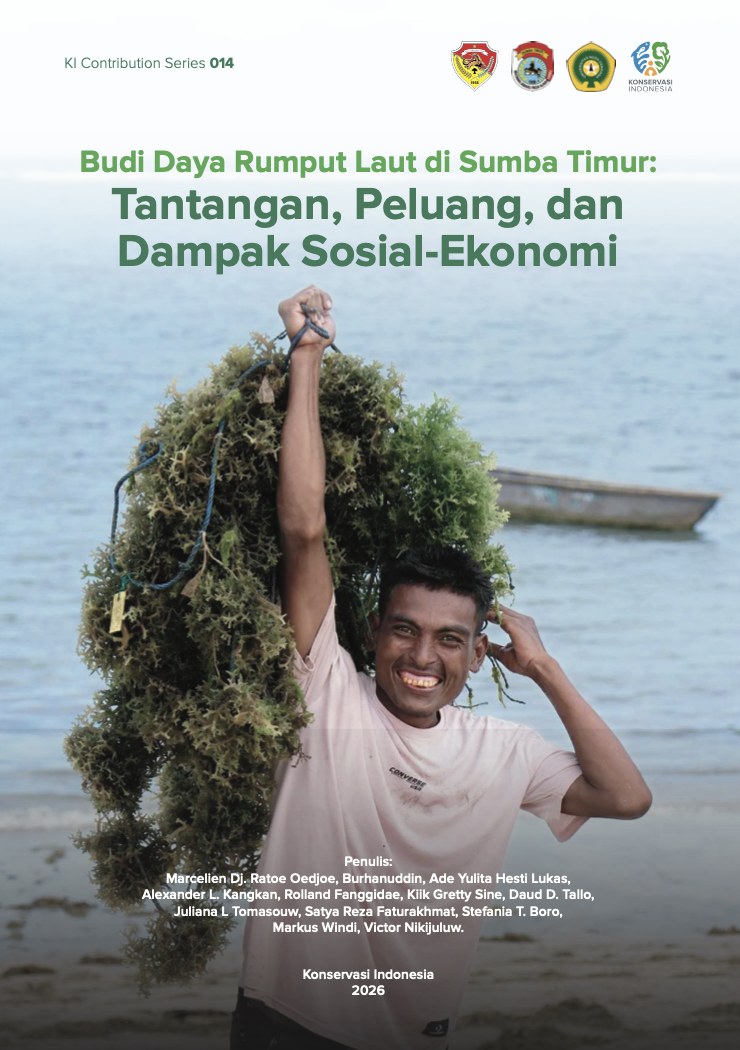
Seaweed farming significantly contributed to the coastal village economy. There are about 63,430 seaweed farmers in NTT (DKP-NTT, 2025). With an average household size of four, there are about 253,720 people directly depending on the seaweed economy. Indirectly, there are also seaweed industry-related activities such as production input supply, processing, and marketing that give employment opportunities to local residents. It is estimated that about half a million of the NTT population directly and indirectly engage in the seaweed industry. For that reason, the provincial government has prioritized seaweed as one of the industrial downstream (hilirisasi) programs that will bring about more signifi cant economic impact to the province.
The potential NTT seaweed farming area is about 62,101 hectares (ha), distributed across small and large islands of the province (DKP-NTT and FPIK-UKAW, 2025). However, the potential is underutilized due to a lack of capital, insuffi cient knowledge, unavailability of enough seed, and minimal local government-empowering policies and programs.
Most of the small-scale seaweed growers, including fishing families, are not financially capable of investing in and commencing seaweed farming. They rely on government aid and subsidies. They are also not eligible for commercial, or even subsidized, bank credits. Availability of investment capital, therefore, is a crucial element in seaweed farming development.
Another determining factor in the success of seaweed farming is the availability of quality seeds. A seaweed seedling is a cutting or fragment of a mature seaweed plant used to grow new plants, a process often called vegetative propagation. High quality and quantity of seedlings are vital components to further the NTT seaweed industry. It is a major obstacle in advancing the seaweed industry (Retang, 2023; Ratoe-Odjoe et al., 2019).
Coastal residents of NTT rely on seaweed farming. It is a coastal household lifeline for many people, especially where economic opportunities are limited due to resource scarcity and disadvantageous environmental conditions. Growing seaweed tends to be the last economic resort for coastal communities. It provides a source of income and opens opportunities for the family to experience decent rural life. As demand for seaweed continues to rise globally (Cueff , 2024), these communities are fi nding new avenues for stability and resilience.
Future development of NTT seaweed should be based on the environmental carrying capacity. The carrying capacity is estimated by considering all relevant ecological, technical, and biological parameters (Bessie et al., 2023). Social and economic variables that basically refl ect social carrying capacity should also be considered in determining sustainable seaweed farming in NTT (Sunadji et al., 2024).
This paper presents parts of the results of the study on the NTT seaweed economic potential and sustainability collaboratively conducted by Konservasi Indonesia (KI), University of Nusa Cendana (UNDANA), and Universitas Kristen Artha Wacana (UKAW) carried out in 2023. The study focused on seaweed cultivation area suitability, identification of new seaweed species that are potentially cultivated, and social economic conditions. The sample areas were East Sumba Regency and Kupang. Sampled farmers were from East Sumba, while processing companies were from Kupang. Findings from sampled areas were connected and inductively applied at the provincial level.